Can You Fix a Chipped Tooth? 5 Treatment Options Explained by Dentists.
A chipped tooth can happen after biting something hard or an accident. Learn when a minor chip can be repaired with bonding or veneers, and when a crown or other dental treatment may be needed.
A chipped tooth can happen after biting something hard or an accident. Learn when a minor chip can be repaired with bonding or veneers, and when a crown or other dental treatment may be needed.
You bite into something hard and suddenly notice that part of your tooth has chipped. Or perhaps you wake up one morning and discover a small piece of your tooth is missing.
A chipped tooth can be alarming, but don’t panic. Most chipped teeth can be repaired, and the treatment depends largely on how much of the tooth has been damaged.
Sometimes a tiny chip only needs a quick cosmetic repair. In other cases, a larger fracture may require a crown or even root canal treatment.
If you’re looking for chipped tooth treatment in Dubai, here’s what you should know about the causes, treatment options, and when you should see a dentist.
What Causes a Chipped Tooth?
Teeth are remarkably strong, but they’re not indestructible. Several things can cause a tooth to chip or break.
Common causes include:
- Biting hard foods such as ice or nuts
- Accidents or sports injuries
- Falls or impact to the face
- Teeth grinding or clenching
- Large or old fillings weakening the tooth
- Tooth decay
- Naturally weakened enamel
- Using your teeth to open packages or bottles
Sometimes, a tooth can chip without any obvious accident. If that happens, underlying decay or a weakened tooth structure may be responsible.
Is a Chipped Tooth a Dental Emergency?
Not every chipped tooth requires emergency treatment.
If you’ve lost only a tiny piece of enamel and don’t have pain, swelling, or bleeding, you can usually arrange a regular dental appointment.
However, you should seek prompt dental care if you experience:
- Severe or persistent pain
- Significant sensitivity
- Bleeding that doesn’t stop
- Swelling around the tooth or face
- A large portion of the tooth breaking off
- A sharp edge cutting your tongue or cheek
- Difficulty biting or closing your mouth
- A visible crack extending toward the gum
If the tooth has been knocked out completely, that’s a dental emergency and requires immediate attention.
5 Treatment Options for a Chipped Tooth
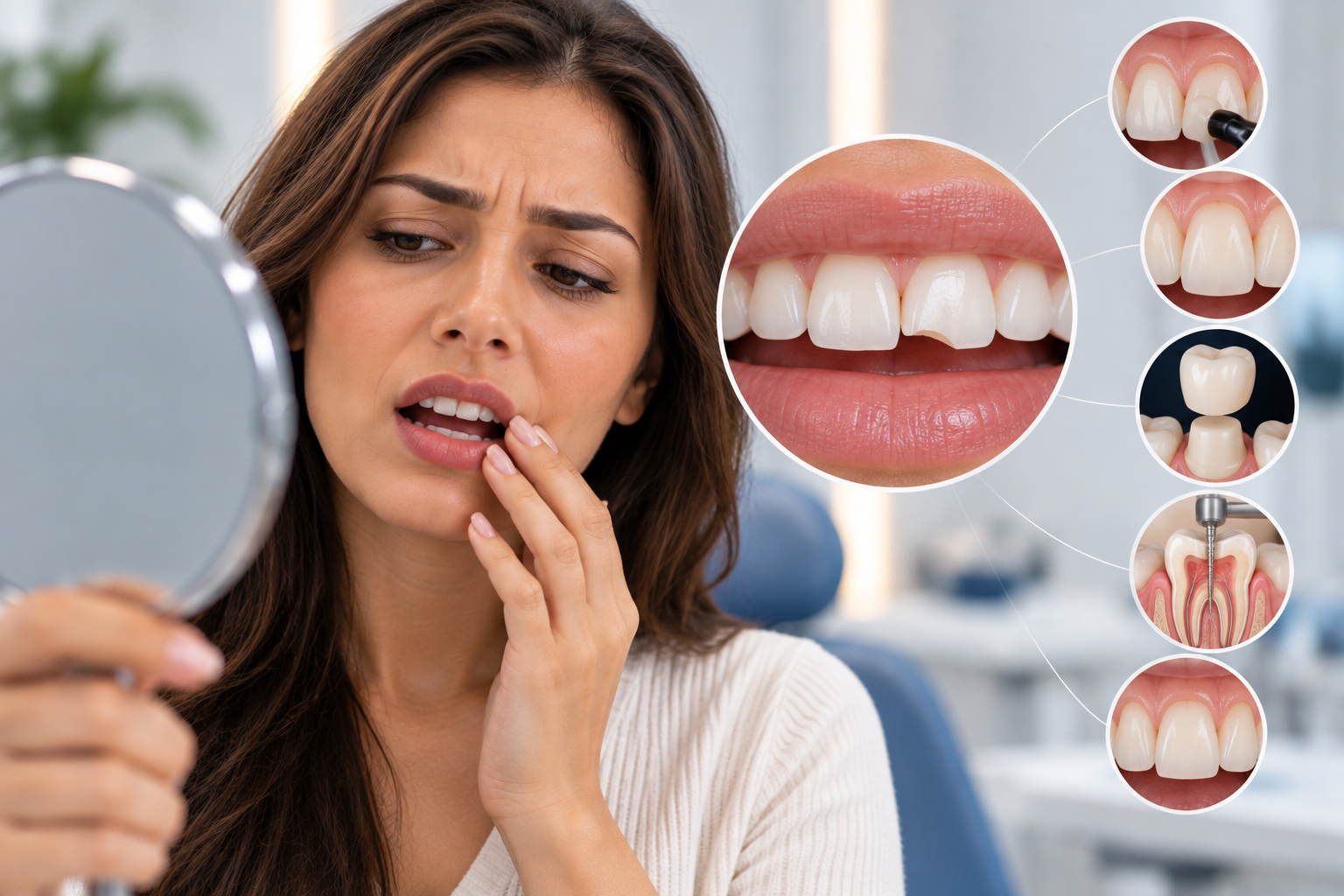
The right treatment depends on the size and location of the chip, the condition of the remaining tooth, and whether the nerve inside the tooth has been affected.
1. Dental Bonding
For a small chip, dental bonding may be all you need.
During bonding, your dentist applies a tooth-colored composite resin to the damaged area and carefully shapes it to recreate the missing portion of the tooth.
The material is then hardened and polished.
Bonding is particularly useful for small chips on visible teeth because the composite can be matched closely to your natural tooth color.
Advantages include:
- Usually completed in one appointment
- Minimally invasive
- Natural-looking results
- Generally more affordable than veneers or crowns
- Preserves most of the natural tooth
2. Dental Veneers
If the damage is mainly cosmetic and the tooth is otherwise healthy, a veneer may be an option.
A veneer is a thin custom-made shell placed over the front surface of a tooth. It can improve the appearance of chipped, discolored, uneven, or slightly misshapen teeth.
Veneers are generally more suitable for cosmetic concerns than teeth with significant structural damage.
Your dentist will assess whether enough healthy tooth structure remains before recommending this option.
3. Dental Crowns
A crown may be recommended when a significant portion of the tooth has broken or the remaining tooth has become structurally weak.
Instead of repairing just the chipped area, a crown covers the tooth to restore its shape, strength, and function.
Crowns can be particularly useful for molars and premolars because these teeth experience substantial chewing forces.
Your dentist will determine whether a crown is appropriate based on the extent of the damage.
4. Root Canal Treatment + Crown
What happens if the chip or fracture reaches the inner pulp of the tooth?
In that situation, a simple filling or cosmetic repair may not be enough.
If the pulp becomes irreversibly inflamed or infected, root canal treatment may be necessary. The damaged pulp is removed, the inside of the tooth is cleaned and sealed, and a crown may then be placed to protect the remaining tooth structure.
Not every broken tooth requires a root canal. Your dentist will assess the tooth and use appropriate tests and imaging to determine whether the nerve has been affected.
5. Tooth Extraction and Replacement
In severe cases, a tooth may be too badly fractured or damaged to restore predictably.
If the tooth cannot be saved, extraction may be necessary. Your dentist can then discuss replacement options such as a dental implant, bridge, or denture depending on your situation.
The goal is generally to preserve the natural tooth whenever it can be safely restored.
What Happens If You Leave a Chipped Tooth Untreated?
A small chip may not seem important, especially if it doesn’t hurt.
However, leaving a damaged tooth untreated can sometimes create additional problems.
A rough or fractured surface can make cleaning more difficult and may trap food and bacteria. A weakened tooth may also be more vulnerable to further damage.
If the chip is related to decay or a deeper crack, delaying treatment could allow the underlying problem to progress.
That’s why it’s worth having even a painless chipped tooth examined.
How Much Does Chipped Tooth Treatment Cost in Dubai?
The cost of tooth repair in Dubai varies depending on the treatment required.
Factors that can affect the price include:
- Size and severity of the damage
- Location of the tooth
- Type of restoration
- Material used
- Whether the tooth requires root canal treatment
- Whether additional X-rays or diagnostic procedures are needed
- Dentist and clinic expertise
A small composite bonding procedure will generally involve a different level of treatment from a crown or root canal.
Your dentist should provide a treatment plan and explain the expected costs before proceeding.
How Can You Prevent Chipped Teeth?
You can’t prevent every dental accident, but you can reduce your risk.
Avoid chewing ice or extremely hard objects, don’t use your teeth as tools, and consider wearing a properly fitted mouthguard if you participate in contact sports.
If you grind or clench your teeth, talk to your dentist about whether a night guard could help protect your teeth.
Regular dental check-ups are also important because untreated cavities and worn restorations can weaken teeth.
Get Your Chipped Tooth Checked in Dubai
A chipped tooth doesn’t necessarily mean extensive dental treatment. The earlier you have it examined, the easier it may be to determine the simplest and most appropriate solution.
At RUH Al Barsha Dental Clinic, our dental team provides restorative and cosmetic dental treatments, including dental bonding, veneers, crowns, and root canal treatment. We assess the condition of your tooth carefully before recommending the right option.
Whether you’ve experienced a recent dental injury or have been living with a chipped tooth for months, don’t leave it to chance.
Book a consultation at RUH Al Barsha Dental Clinic today and find out how we can restore your tooth, protect your smile, and help you feel confident again.
Your symptoms need an individual assessment.
Dental symptoms can have more than one cause. A dentist may need an examination, X-ray or scan before deciding which treatment is appropriate.
Learn more before your consultation.
Explore the relevant treatment guide for suitability, common reasons patients ask about it, the care journey and questions to discuss with your dentist.
Explore Treatment Guides